

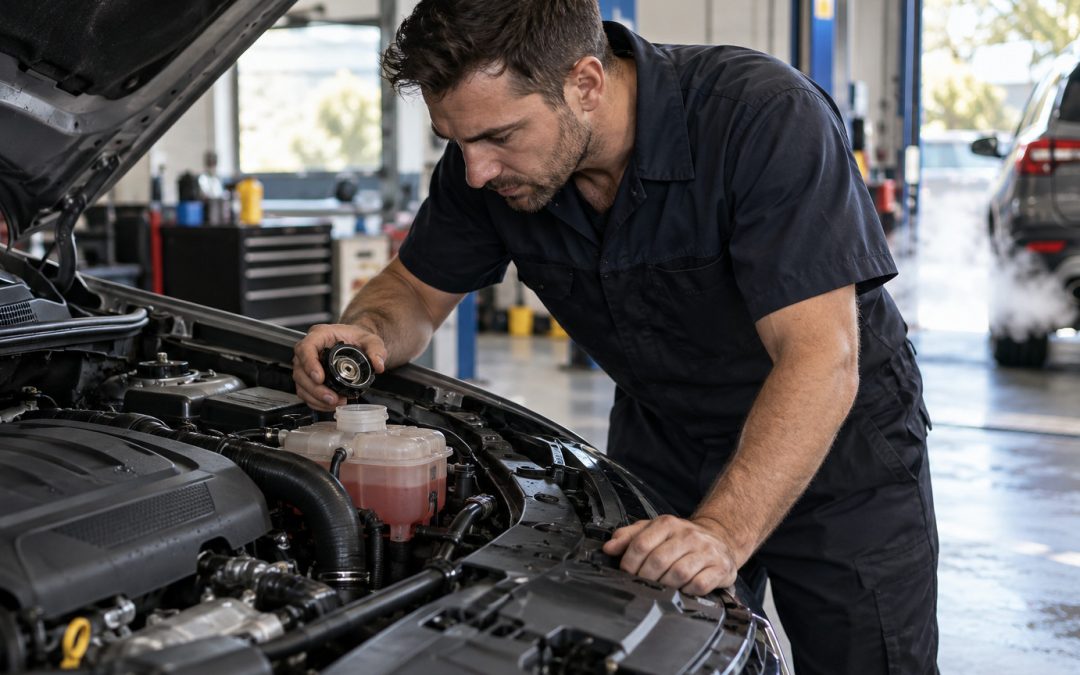
Four signs point at the head gasket, the seal between the two halves of your engine, rather than at something cheaper. Coolant going down with no puddle on the driveway. White smoke that keeps coming once the engine is warm. Oil that looks like milky coffee. Bubbles rising in the radiator or the overflow bottle. One of those on its own usually turns out to be something else. Two or three together usually is the gasket.
The temperature gauge is what most drivers notice first, and it picks its moment. A crawl on the Tullamarine Freeway on a hot afternoon, or twenty minutes in the airport pick-up queue with the aircon on. A cooling system that copes at freeway speed can still run hot in traffic. The gauge tells you to look. It does not tell you what you are looking at.
The table sorts what you can see from what it usually means. One row is there to rule a fault out.
| What you are seeing | Most likely cause | How urgent |
|---|---|---|
| Coolant going down with no puddle underneath | Coolant is leaving the system where you cannot see it, which includes into the engine | Check the level before each drive, and book it in this week. Do not drive it with the level below the mark |
| White smoke that keeps coming once the engine is warm | Coolant burning inside the cylinders | Stop driving it |
| Oil like milky coffee on the dipstick or under the oil cap | Oil and coolant have mixed | Stop driving it. Oil in that state does not protect the engine |
| Bubbles rising in the radiator or the overflow bottle | Combustion gas pushed into the cooling system | Stop driving it |
| Steam from the tailpipe on a cold morning that clears in a minute | Condensation, not a fault | Nothing to do |
| The temperature gauge above its normal spot | Anything from a low coolant level to the head gasket | Pull over and switch off. Do not drive it hot |
This is a general guide. What is wrong with your car depends on the engine, its history, and what a workshop finds when it tests the cooling system.
What a blown head gasket does to an engine
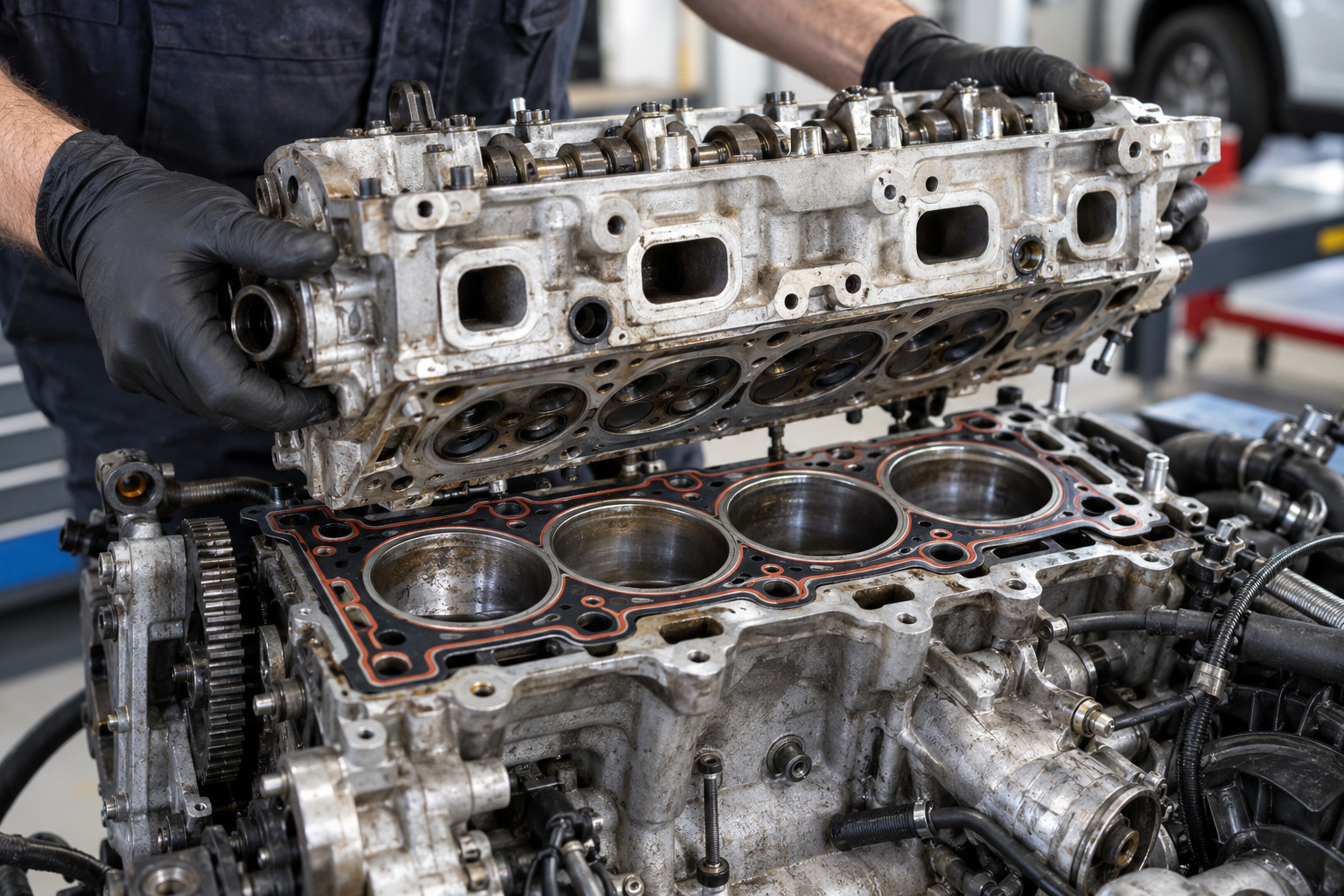
The head gasket seals the join between the two big parts of an engine. Underneath is the engine block, which holds the cylinders. Bolted on top is the cylinder head, the casting that carries the valves and closes off each cylinder. Combustion, the burning of fuel and air, happens in the space between them.
Three things cross that join and none of them should meet. Coolant passes through to carry heat away. Oil passes through to lubricate the top of the engine. Combustion pressure is meant to stay in the cylinder. The gasket keeps all three in their own passages, and it is built to last. A head gasket should see out many years and 200,000km or more.
When it fails, the three start mixing. Coolant gets into a cylinder and burns off. Combustion gas gets into the coolant. Oil and coolant find each other. Every sign below comes from one of those three.
The signs that point to the head gasket
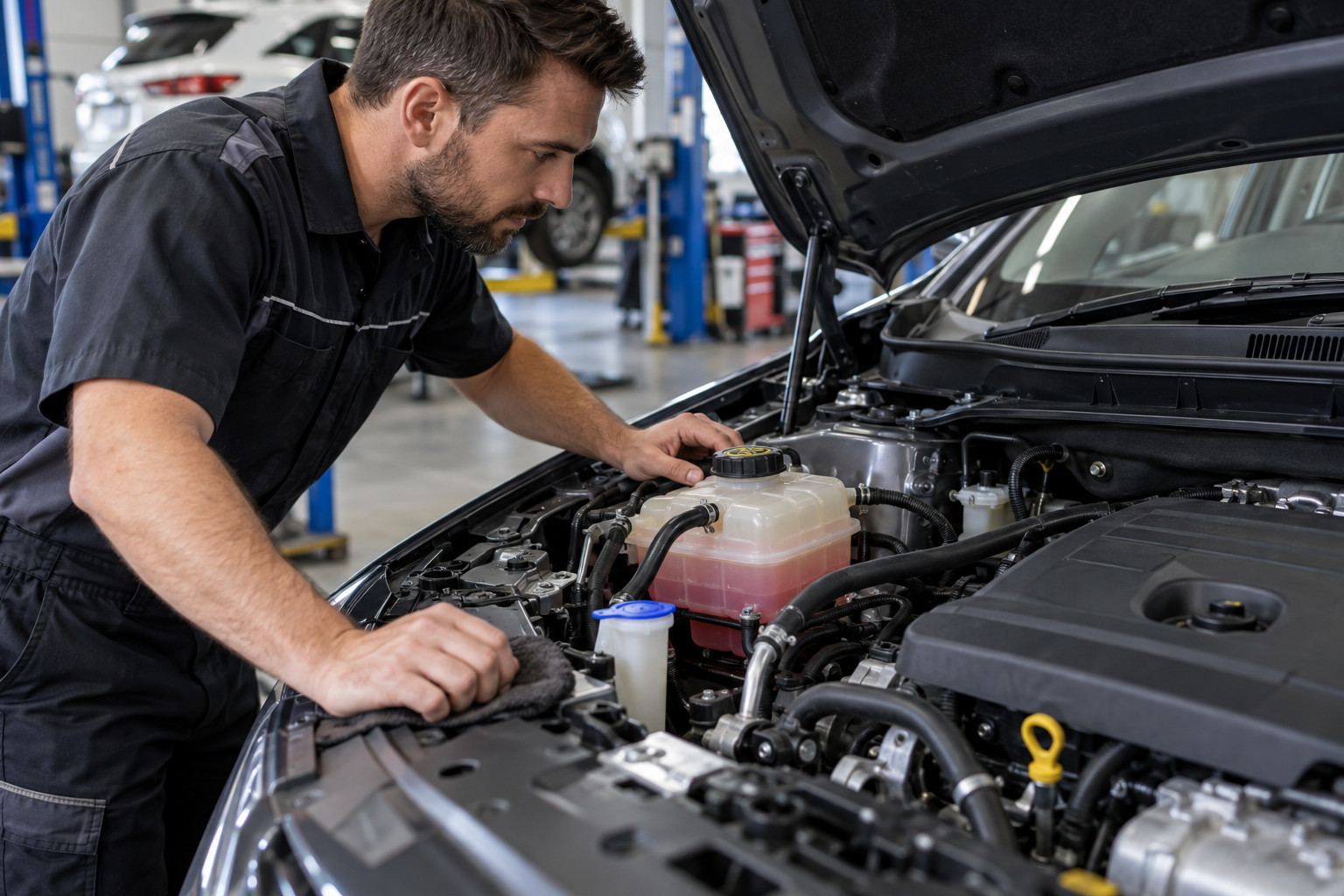
Where the coolant goes matters more than how fast it goes. That is what separates a gasket from a leaking hose.
Coolant going down with no puddle on the driveway. Coolant that leaves a cooling system has gone somewhere. If nothing is dripping and the level keeps falling, it is going somewhere you cannot see. Into a cylinder to be burnt is one of those places. Drivers top this one up for months, because nothing looks wrong.
White smoke that keeps coming once the engine is warm. A short puff of white vapour on a cold start is normal condensation. It clears within a minute or two. Smoke still there once the engine is up to temperature is different. Thick white smoke means coolant is reaching the combustion chamber and burning with the fuel.
Oil that looks like milky coffee. Pull the dipstick, then look under the oil cap. Healthy oil is clear brown or black. A pale, creamy sludge means oil and coolant have mixed. Oil like that cannot lubricate, so this is the sign that should stop you driving at all.
Bubbles rising in the radiator or the overflow bottle. A cooling system holds no air. Gas getting past the gasket has nowhere to go but into the coolant. It shows as bubbles working up through it while the engine runs. That same gas is why a failing gasket drives the system’s pressure up.
What else it could be
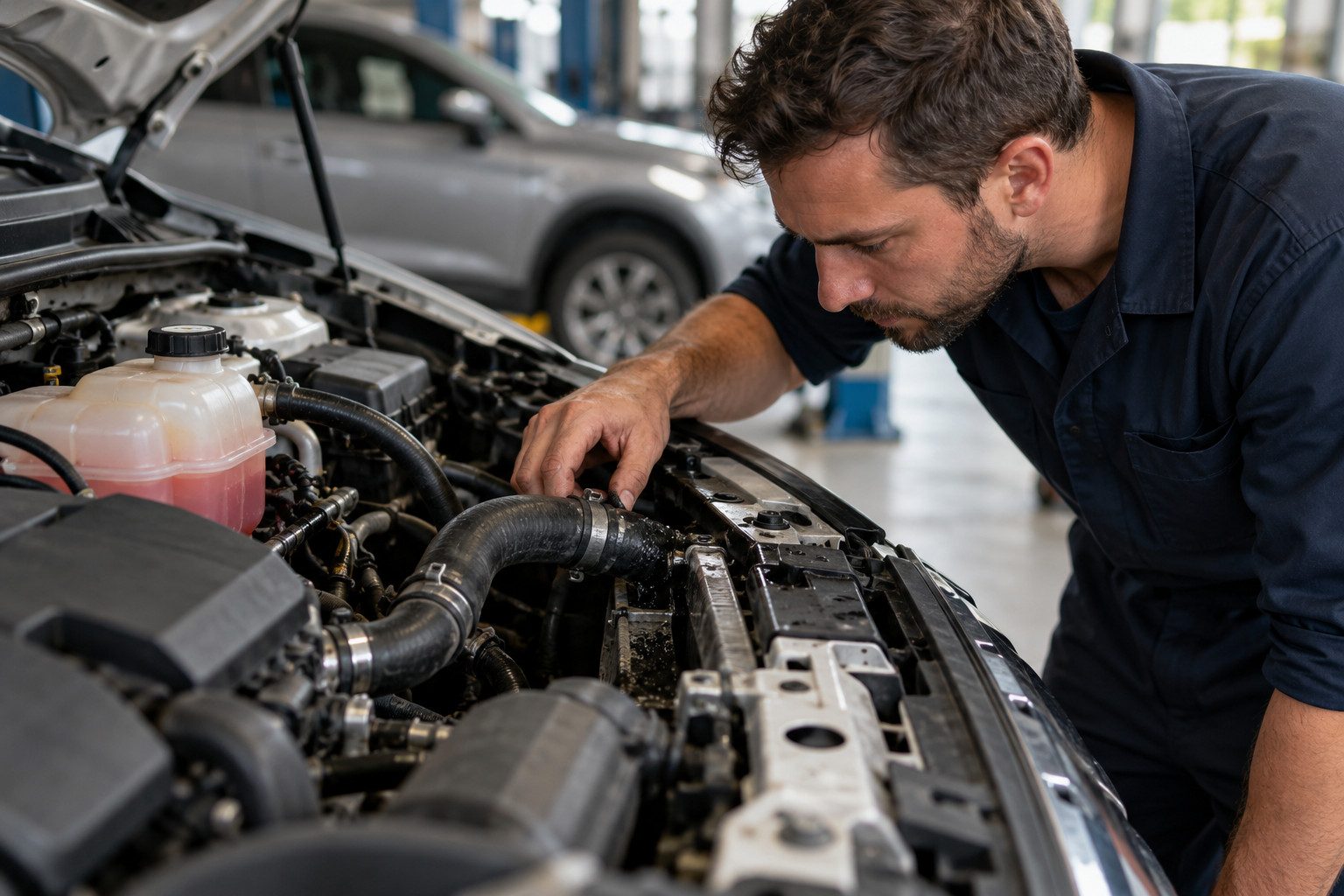
This is the part the cost guides skip. Every sign above has a cheaper look-alike.
A radiator or hose leak. The most common reason a car loses coolant. A cracked hose, a loose clamp or a weeping radiator seam copies the falling level. It usually leaves a puddle or a wet trail to prove it. It cannot make your oil milky and it cannot put bubbles in the coolant. Radiator faults have their own signs and are covered separately.
A failing water pump. The pump pushes coolant through the engine. When it stops moving coolant properly, the engine runs hot even with a full system. A worn pump often weeps from its own housing, so it copies the coolant loss too. The oil stays clean.
A leaking heater core. Your heater runs off the same coolant. The heater core is a small radiator behind the dash. When it leaks, the coolant goes into the cabin, not onto the driveway. That copies a falling level with nothing underneath. A pressure test checks it along with the hoses and the radiator seams.
A stuck thermostat. The thermostat controls how much coolant flows to the radiator. Stuck shut, the coolant stops circulating and the temperature climbs. Stuck open, the engine never warms up properly. Either way the gauge reads oddly. The oil and the coolant stay separate.
A loose or perished radiator cap. The cap is the safety valve on the cooling system. It holds pressure so the coolant can get hotter without boiling. A cap that no longer seals lets pressure and coolant escape, so the level drops with nothing visible below. It is the cheapest part on this list and one of the quickest to test.
A gauge climbs for plenty of reasons that have nothing to do with the gasket. Everything else that makes an engine run hot is covered in more detail elsewhere on this site.
How a workshop tells the difference
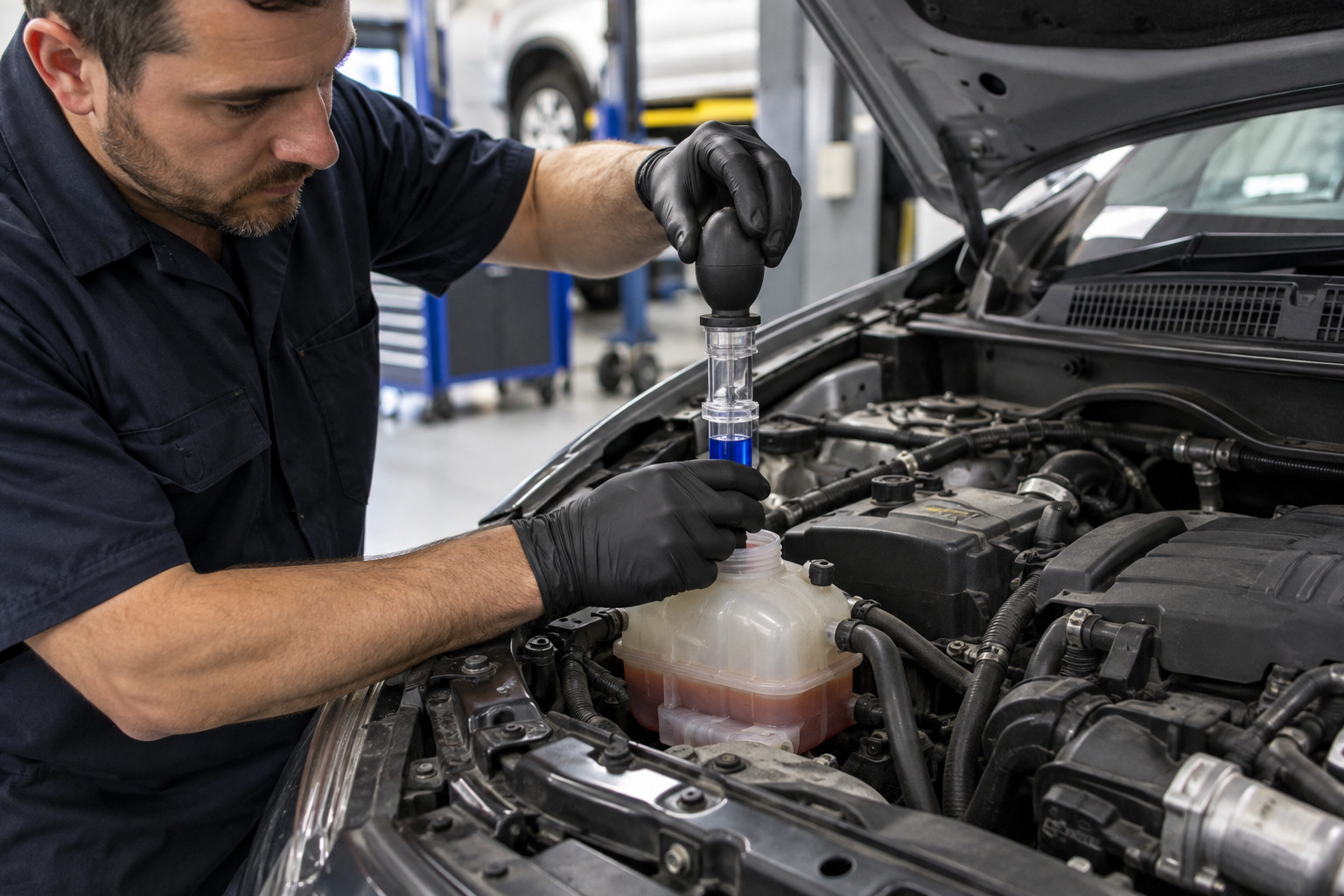
Three tests separate a head gasket from the faults above. None of them needs the engine pulled apart.
A cooling system pressure test. A hand pump replaces the radiator cap, and the system is brought up to the pressure marked on that cap. A system in good order holds steady. A drop means something is leaking. The hoses, radiator seams, heater core and engine then get checked to find where. This test answers whether the system holds pressure, not whether the gasket is the reason.
A combustion gas test on the coolant. The coolant is tested chemically for exhaust gas. Gas in the coolant means combustion pressure is escaping into the cooling system, and a failed gasket is the usual route. A cracked cylinder head or a cracked block can do the same. A clear result does not clear the gasket completely, because a gasket can pass coolant into the oil instead.
A compression test. Each cylinder is measured for the pressure it holds. Where the gasket has failed, compression in that cylinder leaks away into the cooling system. The reading comes back lower than its neighbours. That points at which cylinder is involved, and where to look.
A system that holds pressure, a coolant test that stays clear and even compression across the cylinders make the head gasket unlikely.
Can you keep driving with a blown head gasket?

No, and not even a short distance. Combustion gas pushed into the cooling system makes the pressure in that system spike. That drives the temperature up further. The car gets hotter the longer it runs. Australian motoring clubs are blunt about pushing on: driving even a very short distance can greatly increase both the damage and the repair bill.
Heat is what turns a gasket job into a bigger one. An engine run hot enough can warp its cylinder head. A warped head will not seal against a new gasket. It then has to be machined flat or replaced, which costs a good deal more than the gasket did.
What to do instead:
- Pull over somewhere safe as soon as you notice, and switch the engine off.
- Leave the bonnet closed and let the engine cool. That takes more than an hour, not ten minutes.
- Never loosen the radiator cap while the engine is hot. The coolant is pressurised and will scald.
- Once it is cool, check the coolant level. If it sits below the mark, the car should not be driven.
- Have the cooling system tested before the car is driven again, rather than topping it up and hoping.
What a head gasket repair involves
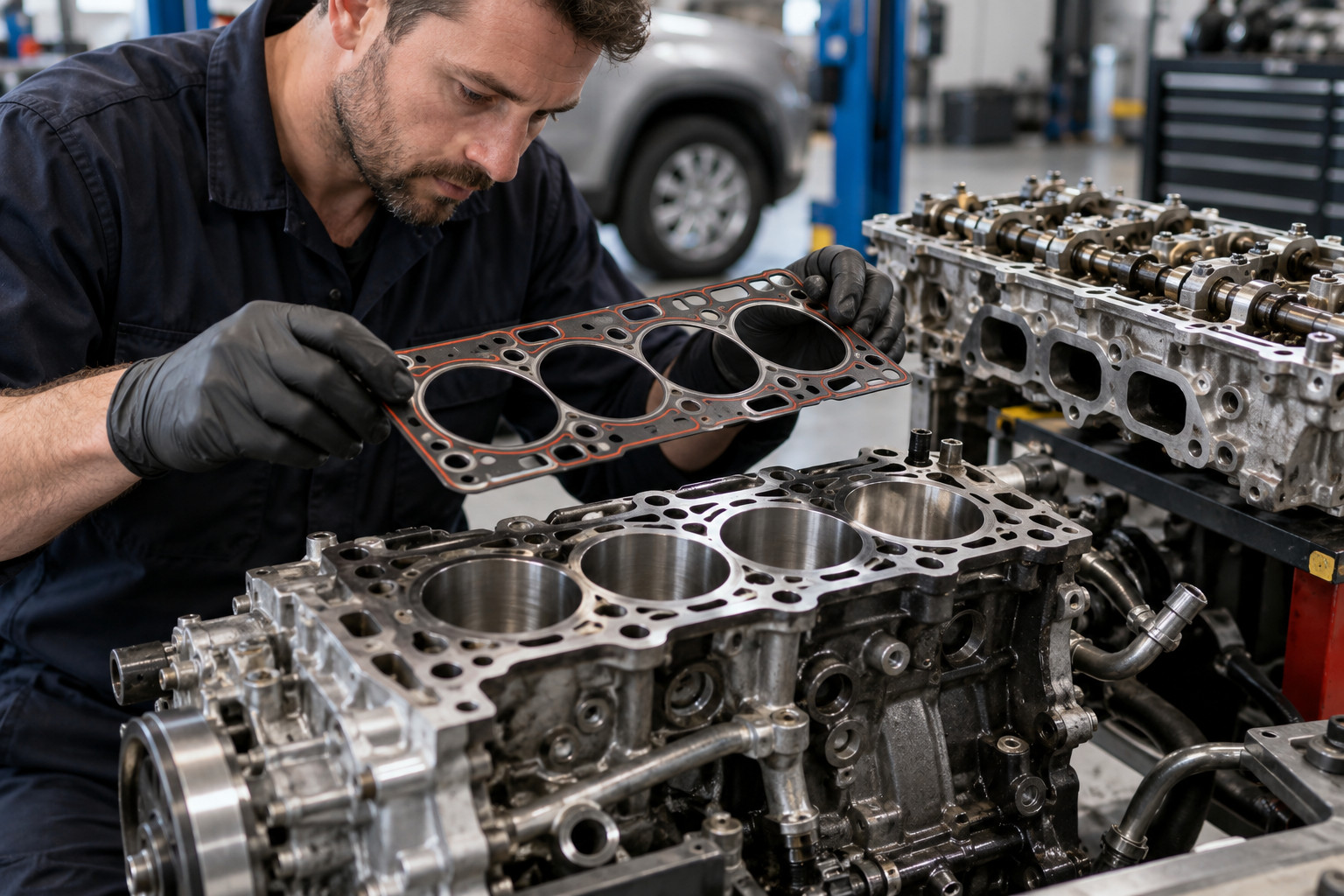
The head comes off. That is why the job costs what it does. Almost all of it is labour, and the gasket itself is a small part of the bill.
With the head off, both faces are checked for flatness with a precision straightedge. A new gasket cannot seal against a surface that is no longer flat. A head outside the engine maker’s limit is machined flat, and a cracked one is replaced. On many engines the timing belt or chain has to come off to reach the head, so it is usually renewed while everything is apart.
Four things move the price. The engine layout and how buried the head is. Whether the head needs machining. Whether the belt or chain and the water pump are done at the same time. How much damage the overheating did before the car stopped. Published Australian cost guides put a head gasket replacement between about $1,000 and $3,200 as a general market range. A quote for head gasket and cylinder head work depends on which of those four apply to your engine.
On a high-kilometre car the sum is usually still worth doing, because a sound engine is worth more than the repair. Whether the car is worth keeping is a bigger question than this one.
A cooling system check is the cheap end of this subject. Coolant going down, or a gauge higher than normal on the drive home, is reason enough to look now. Book a cooling system check with VP Autocare before it becomes a head gasket. A pressure test and a coolant test take a fraction of the time the repair does.
Frequently asked questions
Can a head gasket fail without the car overheating?
Yes. A gasket leaking coolant into the oil can show up as milky oil while the gauge sits where it always does. A slow loss of coolant can do the same. That is why the four signs count for more than the temperature reading alone.
Why is a head gasket repair so expensive when the gasket is cheap?
You are paying for access. The gasket sits under the cylinder head, so the top of the engine has to come apart to reach it. The part is a small share of the bill and the hours are the rest.
Can I top up the coolant and keep driving?
Topping up hides the symptom and leaves the cause in place. Coolant that keeps disappearing has gone somewhere, and the two places you cannot see are inside the engine and inside the cabin. Get the system tested rather than refilling it every week.


