

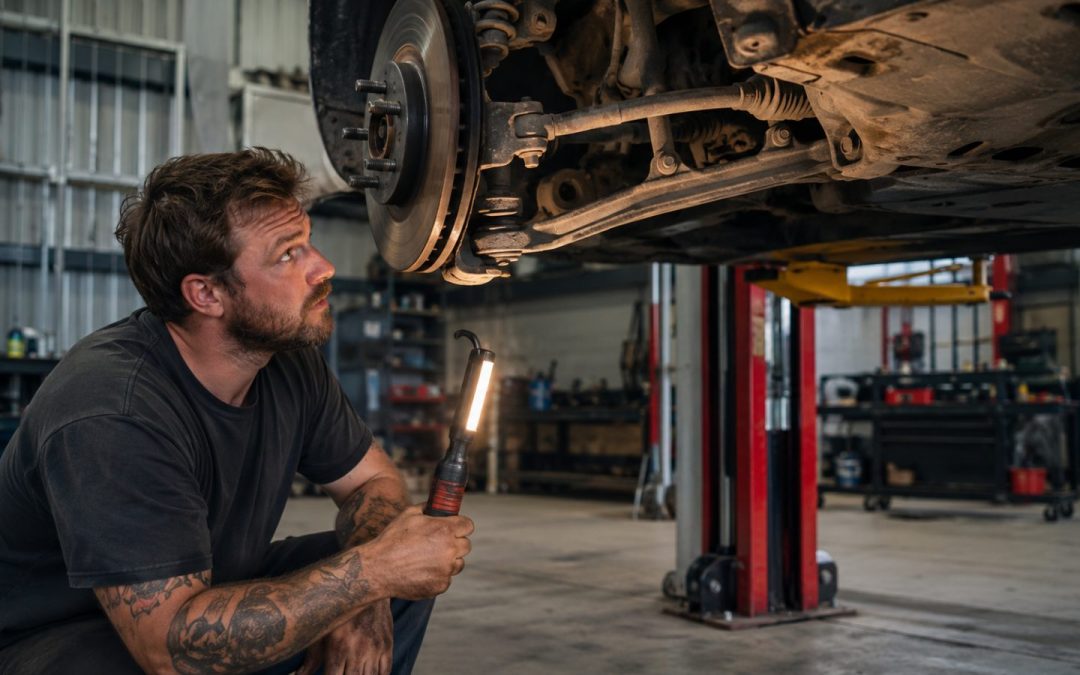
A car safety check is a workshop inspection of the parts that keep a car under control and visible to others. That means brakes, tyres, steering, suspension, lights and fluids. Most of what it finds is measured, not looked at. Pad material, disc thickness and tread depth are all read off a gauge. The suspension is checked with the wheels off the ground. That is the gap it fills. You feel a fault once it has changed the way the car drives. An inspection finds it long before that.
A safety check is usually booked for a reason. A long drive coming up. A car that has sat in the driveway for months. A pothole that hit harder than it should have. Underneath all of them sits one question. Is there something wrong with this car that I would not know about?
The table below sets out three things: what gets checked, what the inspection looks for, and what you would have noticed yourself. The third column is the short one. That is the point.
| What gets checked | What the inspection is looking for | What you would notice yourself |
|---|---|---|
| Brakes | Pad material left, disc thickness against the manufacturer’s minimum, uneven wear between pads, and the condition of the fluid | Usually nothing, until the brakes squeal, feel soft or pull to one side |
| Tyres and wheels | Tread depth in the main grooves, wear across the width, cracking from age, and pressures | A tyre that looks low, or one worn down far enough to see from standing |
| Steering and suspension | Play in joints and bushes, leaking shock absorbers and worn mounts, all checked with the wheels off the ground | Vague or loose steering, months after it started |
| Lights and electrical | Every globe front and rear, including the number plate lights, plus battery terminals and resting voltage | A headlight out. Rear globes go unnoticed, because you are never behind your own car |
| Fluids and leaks | Levels and condition of oil, coolant and brake fluid, plus weeps at seals, hoses and the radiator | A puddle on the driveway, once a weep has become a leak |
This is a general guide. What gets checked depends on the car’s age, its condition, and what the workshop finds on the hoist.
What a car safety check finds, system by system
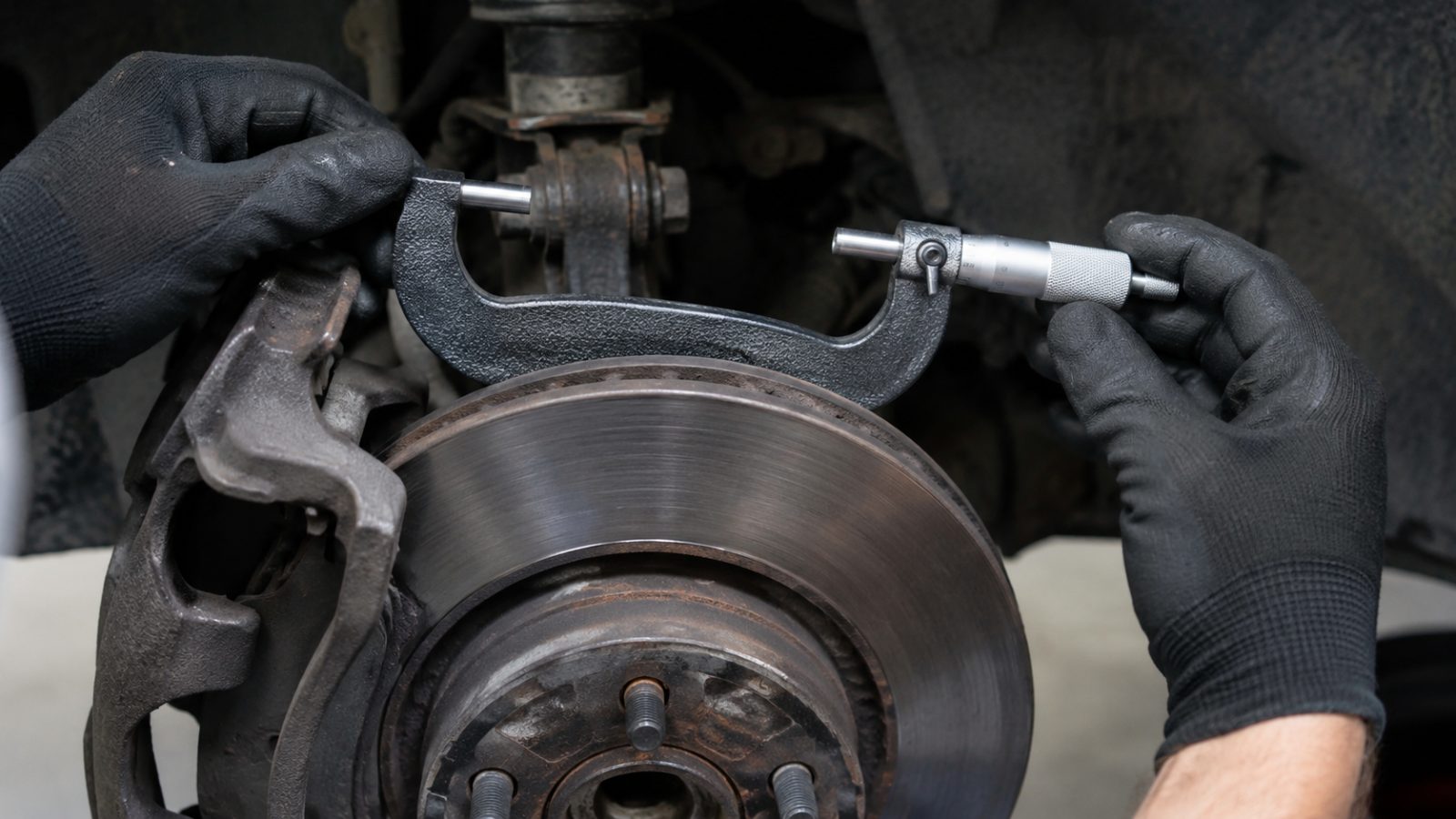
That middle column comes from one of two places. A measurement taken with a gauge, or a look from underneath. Neither is available to you while you are driving.
Brakes. Pad thickness is the check everyone expects. Disc thickness is the one that surprises owners. Every disc carries a minimum thickness set by the manufacturer, stamped on the disc itself. A pad with life left can be sitting on a disc already under it. Uneven wear between the inner and outer pad usually means a seized slide pin, holding the caliper crooked. Brake fluid draws moisture out of the air over the years. That lowers the temperature at which it boils, so its condition gets checked too.
Tyres and wheels. Tread depth is measured in the main grooves. In Victoria, a tyre is unroadworthy below 1.5mm there. Age matters just as much, and gets missed more often. Rubber hardens and cracks as it ages. The Australian Tyre Industry Council’s position is that tyres come off at ten years. That is ten years from the date they were made, whatever the tread looks like. The date sits on the sidewall as a four-digit code, so 4022 means the fortieth week of 2022. Wear on one edge points at the alignment, not the tyre.
Steering and suspension. These checks are done by hand, with the car in the air. A tie rod end is the joint that connects the steering to the wheel. Play in one shows up as a knock when the wheel is rocked. That is months before it makes any noise on the road. A leaking shock absorber wears an oily film down its body. Worn rubber bushes are the ones nobody reads as a fault. They make the steering vague and the car feel loose. Owners put that down to age. If the steering wheel has started shaking at freeway speed, mention it when you book.
Lights and electrical. Every globe gets checked, front and back. The blown ones are usually the ones you never see. A brake light, a rear indicator, a number plate globe. The battery terminals are checked for corrosion, the white or green crust that builds on the posts. Resting voltage is measured too, once the car has sat a few hours. About 12.6 volts means a full battery. A reading of 12.4 means it is already part flat.
Fluids and leaks. Levels are the quick part. Condition takes longer and matters more. Coolant loses its rust protection over the years. It turns from bright to muddy well before it goes low. Underneath, the inspection looks for a weep rather than a leak. That means a damp film with dust stuck to it around a seal. Or a hose gone soft at the clamp. Or a wet patch on the gearbox that has not reached the driveway. A puddle on the concrete is the last stage, not the first.
How a car is driven changes what turns up. A lot of local running around Tullamarine and Gladstone Park is short and stop-start, between the airport, the freight estates and the shops. That pattern is hard on brakes and batteries. It also hides the evidence. The car never goes far enough or fast enough for the wear to show.
What a car safety check does not cover
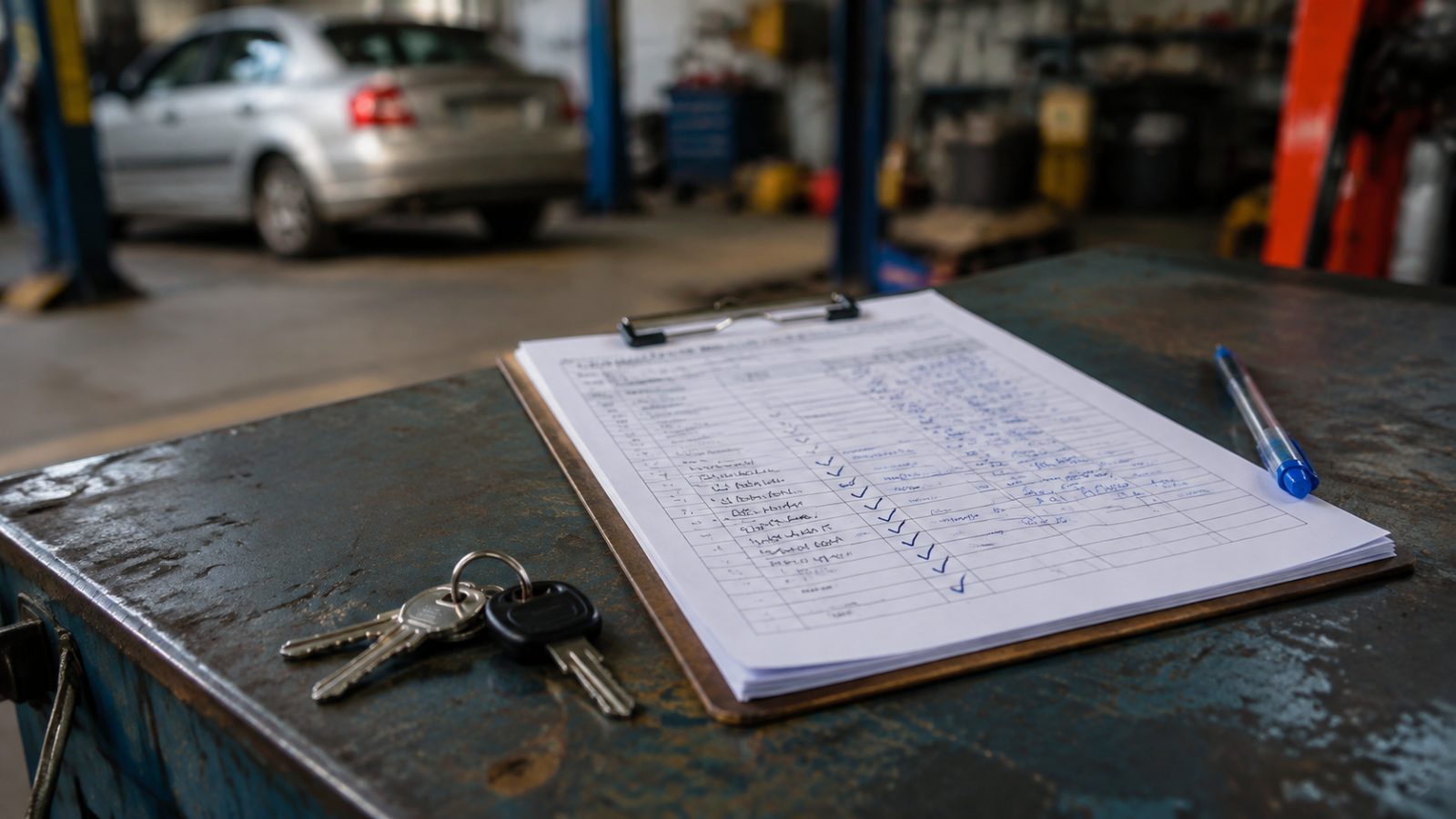
A car safety inspection reports on the car in front of the mechanic, on the day. That is both its strength and its limit.
A safety check is also not a roadworthy certificate. Those are separate pieces of work, under separate rules. You may need a certificate for a sale or a re-registration. If so, the difference between the two is set out in full elsewhere on this site.
- It is not a prediction. A part that measures fine today can fail next month. It tells you what is worn now, not what will break next.
- It is not a warranty. A clean report guarantees nothing for a set time or distance.
- It does not pull things apart. A wheel bearing is checked by feel and by sound, not by stripping the hub. A fault hidden inside a component stays hidden.
- It cannot find a fault you have not mentioned. A noise that comes and goes may not appear on the day. Say so when you book, and somebody can go looking.
- It is not a repair. The check ends with a report of what was found. Nothing gets fixed unless you say so.
When should you book a car safety check?
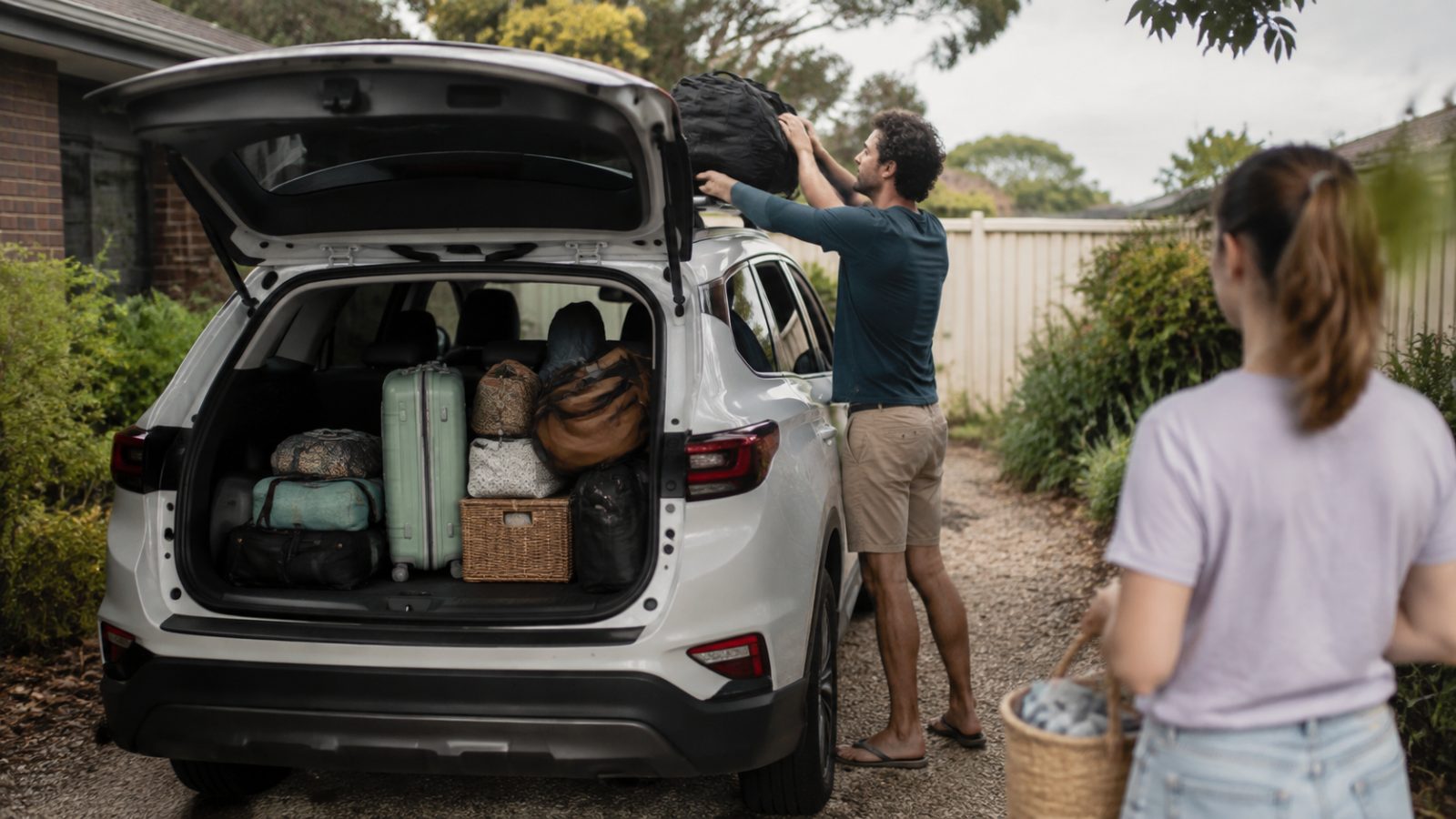
The trigger for a vehicle safety check is an event, not a date. These are the moments where one earns its money.
Buying a used car is the other common trigger. A pre-purchase inspection is a different job, with its own scope. It is worth booking as one.
- Before a long drive with the car loaded. A run up the Hume with a full boot and four people is a different ask. Brakes and tyres work far harder than they do on the commute.
- After the car has sat. Think of a second car doing short trips only, or one parked for months. It comes back with a tired battery, low pressures and surface rust on the discs.
- After a kerb strike or a bad pothole. The damage lands on the alignment and the suspension. There is usually nothing to see from outside.
- Before a P-plater in the family starts driving the hand-me-down. A new driver has no sense of how that car should feel. A fault getting worse will not register as a change.
- Before towing for the first time in a while. A load on the tow bar changes what the brakes, tyres and suspension are asked to do.
When you probably don’t need one
A car serviced in the last few months rarely needs a separate safety check. Not if it is driven regularly, feels normal, and has no big trip coming. A logbook or standard service already covers the brakes, tyres, lights and fluids. Adding a check on a schedule buys you very little.
One exception is worth naming. If the car is going in for a service anyway, add the check to the same booking. That saves a second trip. It is also worth telling the workshop what you have noticed before they start. An inspection with something specific to look for finds more than one without.
Age on its own is not a trigger. A three-year-old car that only does short runs can need more attention than a well-driven ten-year-old.
If one of those moments is coming up, book before it rather than after. A worn part found before a long drive is a repair. Found afterwards, it has had the whole trip to get worse.
You can see what a car safety check includes on the VP Autocare service page.
If you have already noticed something, say so. A noise, a pull to one side, a soft pedal. The check covers the car either way, but a fault somebody is looking for is a fault that gets found. Mention it when you book a time.
Frequently asked questions
Is a safety check included in a normal car service?
Not as a separate item, though the ground overlaps. The two jobs have different aims. One keeps the car running to its schedule. The other is about what could put you at risk on the road. Where a car has no symptoms and a recent service behind it, that overlap does most of the work.
Does a safety check cover the engine?
Not in the way a service does. The focus is on the parts that keep the car under control and visible to others. The engine comes into it through fluids and leaks, rather than through how it runs. A rough idle or a flat spot is a job for a diagnostic.
Can a safety check be done at the same time as a service?
Yes, and it is the tidy way to handle it. Both go on the one booking and the car only comes in once. That suits anyone with a service due and a trip on the calendar in the same month.
What happens if the check finds something?
You are told what was found and what it means. The decision is yours from there. Some findings need doing before you drive any distance. Others can safely wait for the next service, and the report should make clear which is which.


