

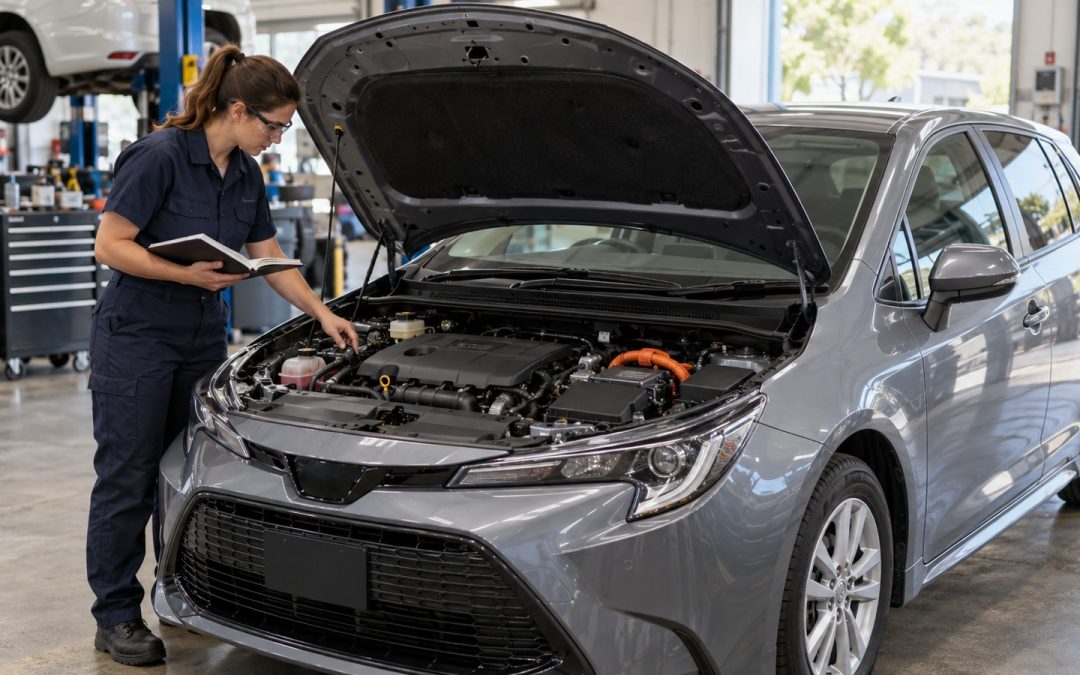
A hybrid still needs its full logbook service, and most of the work is the same as on the petrol car it is based on. What changes is where the attention goes: a scan of the hybrid system, and a small 12 volt battery that is a separate part from the big drive battery. Toyota’s own servicing FAQ says maintenance on a hybrid is very similar to a conventional petrol Toyota.
Hybrid owners hear a version of the same line: these cars barely need looking after. It comes from two true things. The petrol engine shares the work with an electric motor, and the brakes do less of the slowing. Neither of those cancels a service. They change which items on the schedule matter most.
What does a hybrid car service still cover?

A hybrid car service covers the same ground as any logbook service, because most of the car is the same car. Toyota’s published list of service inclusions gives a useful picture of the scope:
That is Toyota’s list for its own cars. It is an example of what a service covers, not a fixed list every workshop runs.
- an engine oil and filter change
- a brake inspection, including changing and flushing the fluid where it is needed
- a battery test, and a check of fluid levels
- a multi-point inspection of mounting points, belts, hoses, and lines
- tyre rotation and a road test
Oil is worth a line of its own. Toyota states that a hybrid will still need its oil changed, just like a conventional petrol or diesel car. The oil recommendation is set out in the owner’s manual.
The rest is ordinary wear. Tyres, steering, suspension, lights, and wipers do not know what is turning the wheels. They age on kilometres, on time, and on the roads the car lives on.
What is different about servicing a hybrid?
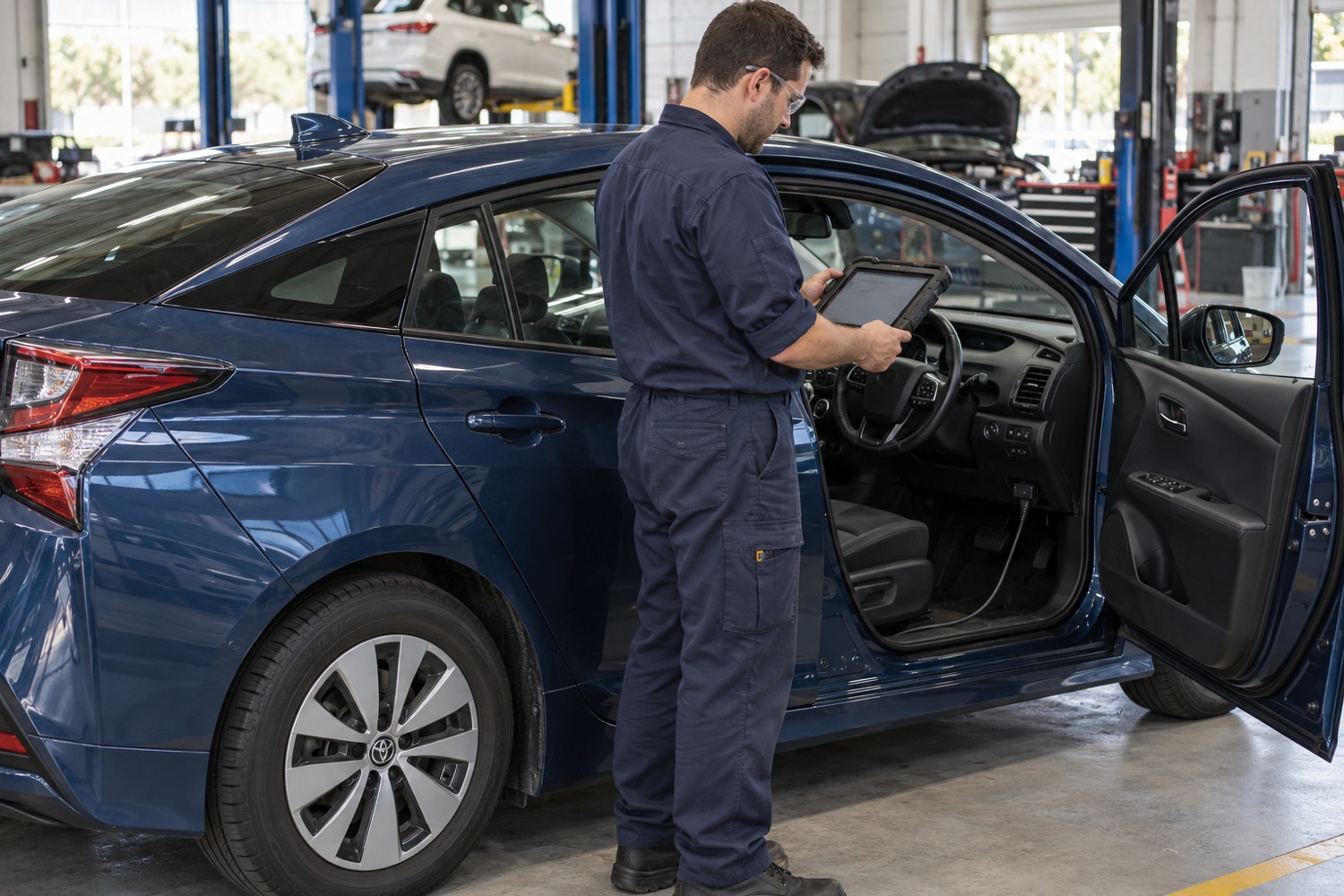
Two things are genuinely different. The car carries two batteries, and the hybrid system is checked electronically.
The traction battery is the large pack that drives the electric motor. The 12 volt auxiliary battery is the small one that runs lights, locks, and the car’s computers. They are different parts with different jobs. Toyota’s warranty terms treat them that way, listing the auxiliary 12 volt battery as covered separately from the traction battery. The warning signs for a 12 volt battery on its way out are the same as on any car. Those signs are set out in battery replacement signs.
The scan is the part with no petrol equivalent. Toyota describes a traction battery health check as a detailed analysis done with a special scan tool. It assesses the health of the hybrid battery and systems, and it forms part of routine maintenance. Its service inclusions also say hybrid and battery electric vehicles get diagnostic scans on top of the standard items. That is one manufacturer describing its own dealer service rather than a description of what every workshop offers.
Hybrids also have to keep the drive battery and the electronics that control it at a sensible temperature. How that is done differs from model to model. What the cooling side needs at a service is set by the maker’s schedule for your car, not by a general rule about hybrids.
Do regenerative brakes still need inspecting?
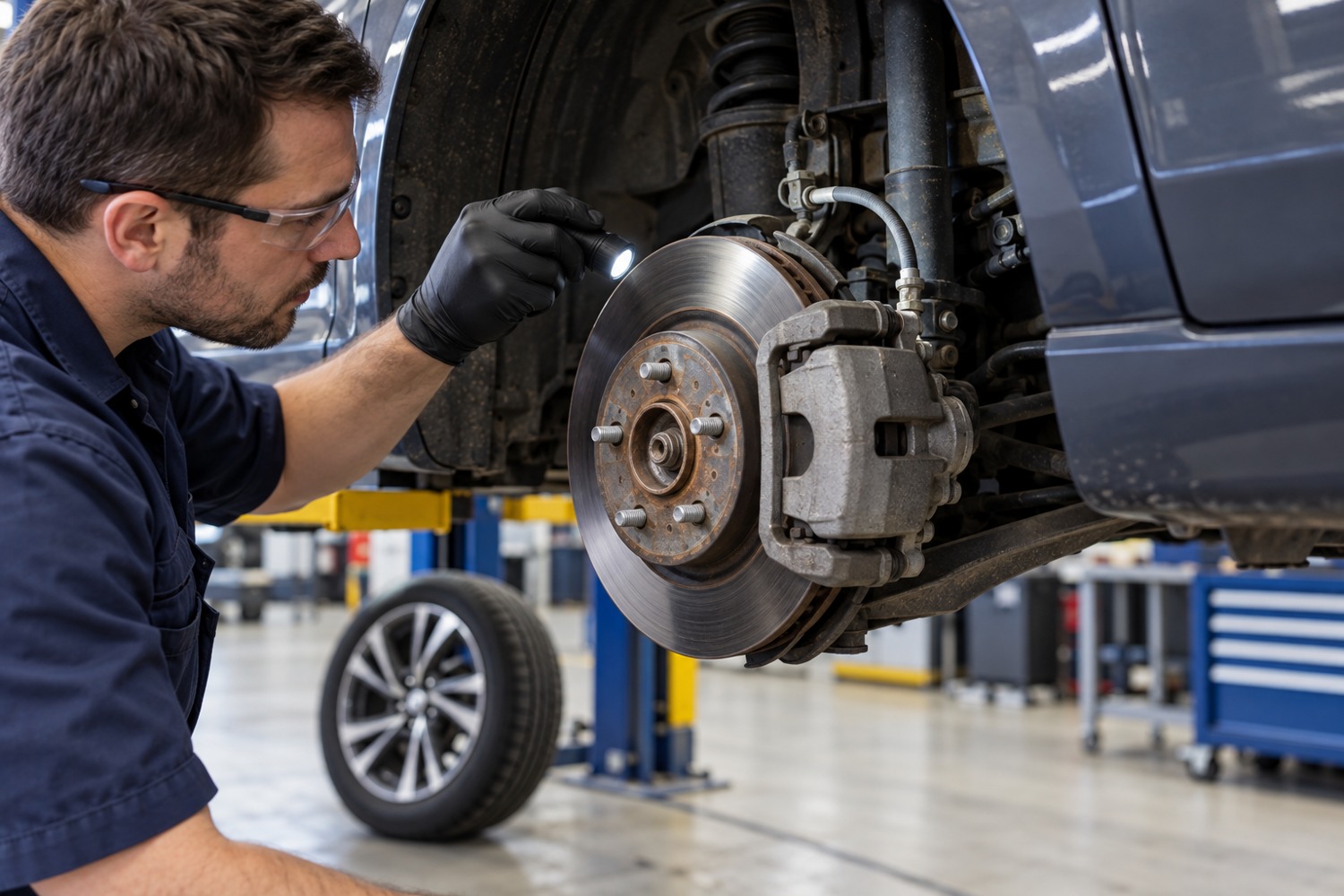
Yes, and on the same schedule as any car. Regenerative braking is one of the ways a hybrid charges itself. Toyota describes a hybrid as self-charging its battery by recovering energy generated by the petrol engine and through regenerative braking. When you lift off or brake gently, some of the slowing happens at the motor instead of at the pads.
Less work for the pads is not no work. How much less depends on the car, the traffic, and the driver, and no honest figure covers every hybrid.
Pads are also only one part of a brake inspection. The fluid, the discs, the calipers that squeeze the pads, the flexible hoses, and the handbrake are all looked at. None of them are affected by where the slowing came from. That is why a brake inspection sits inside the scheduled service rather than waiting for the pads to get thin.
How often should a hybrid be serviced?

On time or distance, whichever comes first. Toyota’s servicing FAQ puts it plainly. Follow the vehicle’s warranty and service book, and complete services on time by either time or kilometres driven, whichever comes first.
The interval itself belongs to the maker, and it is worth looking up rather than assuming. Toyota’s current service pricing terms recommend 12 months or 15,000 km for current-generation passenger and SUV hybrid electric and battery electric models, with two models named as exceptions. The rest of the range is on 6 months or 10,000 km. That is one brand’s recommendation for its current models. It is not every brand, it is not every model year, and your own warranty and service book is the authority for your car. A schedule can also set extra requirements for harder use.
The time half is the easier one to miss. Toyota’s terms are direct about it. A car that is not driven far enough to cover the distance between services should still be serviced on the time period shown in the schedule. A hybrid doing school runs and short hops around Tullamarine can take two years to reach a distance figure it was meant to pass in one. Short-trip wear shows up in batteries and brakes long before the odometer catches up.
Is a hybrid service cheaper than a petrol service?

About the same, at least according to Toyota. Its servicing FAQ says maintenance costs for hybrids are very similar to conventional petrol vehicles. It adds that this depends on factors such as the model, the grade, the age of the vehicle, and the kilometres travelled. That is Toyota talking about Toyotas, not a rule covering every hybrid on the road.
Two things make the comparison harder than it looks. The first is capped-price servicing. Toyota’s capped price servicing runs for the first three or five years from the vehicle’s purchase. A capped price is a manufacturer’s offer with its own conditions attached, not what an independent workshop charges.
The second is that saving on one item does not make a whole service cheaper. Pads that last longer are a real saving. They sit inside a service that still changes the oil, still tests the battery, and still inspects the rest of the car. What yours costs comes down to the model, its age, and what the schedule calls for at that interval. That is why a quote on your own vehicle beats an average.
Keep servicing tied to your car’s schedule

The rule is short enough to remember. Find the schedule for your model, follow it on time or distance, and let the workshop tell you what that particular interval includes.
Hybrid servicing is ordinary mechanical work for the most part, with a system scan and a second battery on top of it. If you bought the car second-hand and no service history came with it, say so when you book. The workshop then works from the published schedule for the model rather than from a stamp nobody can find.
If yours is near its interval, or you have lost track of when it was last done, book a service and take the logbook with you.
Frequently asked questions
Does a hybrid still need an oil change?
Yes. A hybrid runs a normal petrol engine, so it uses oil the way any engine does. The grade for your model is listed in the owner’s manual.
Can regenerative braking replace a brake inspection?
No. Recovering energy takes some load off the pads, but an inspection also covers the fluid, discs, calipers, and hoses. Those are checked on the schedule whatever is doing the slowing.
Should a low-mileage hybrid skip its time-based service?
No. The schedule has two halves, and the first one you reach is the one that counts. Toyota’s terms are explicit that low distance does not postpone a time-based service.
Are dealer capped-price services independent-workshop prices?
No. A capped-price offer comes from the manufacturer and carries its own conditions and time limit. An independent workshop sets its own price, so compare on what the service includes as well as the figure.


